When the Network Goes Down, Cash Still Works
The short version
- Every card payment travels through a chain of private systems: phone networks, cloud providers, software, card schemes and banks. Any link can break.
- It keeps happening: Optus, CrowdStrike, Cloudflare, the Reserve Bank’s own systems, Mastercard.
- When the chain breaks, a card-only counter stops. Cash doesn’t need a signal.
- Friday and Saturday only come 52 times a year. Lose one to an outage and you don’t get it back.
- Cash is public money. The payment networks are privately owned.
- Keep cash in your till and an ATM on site, and you keep trading.
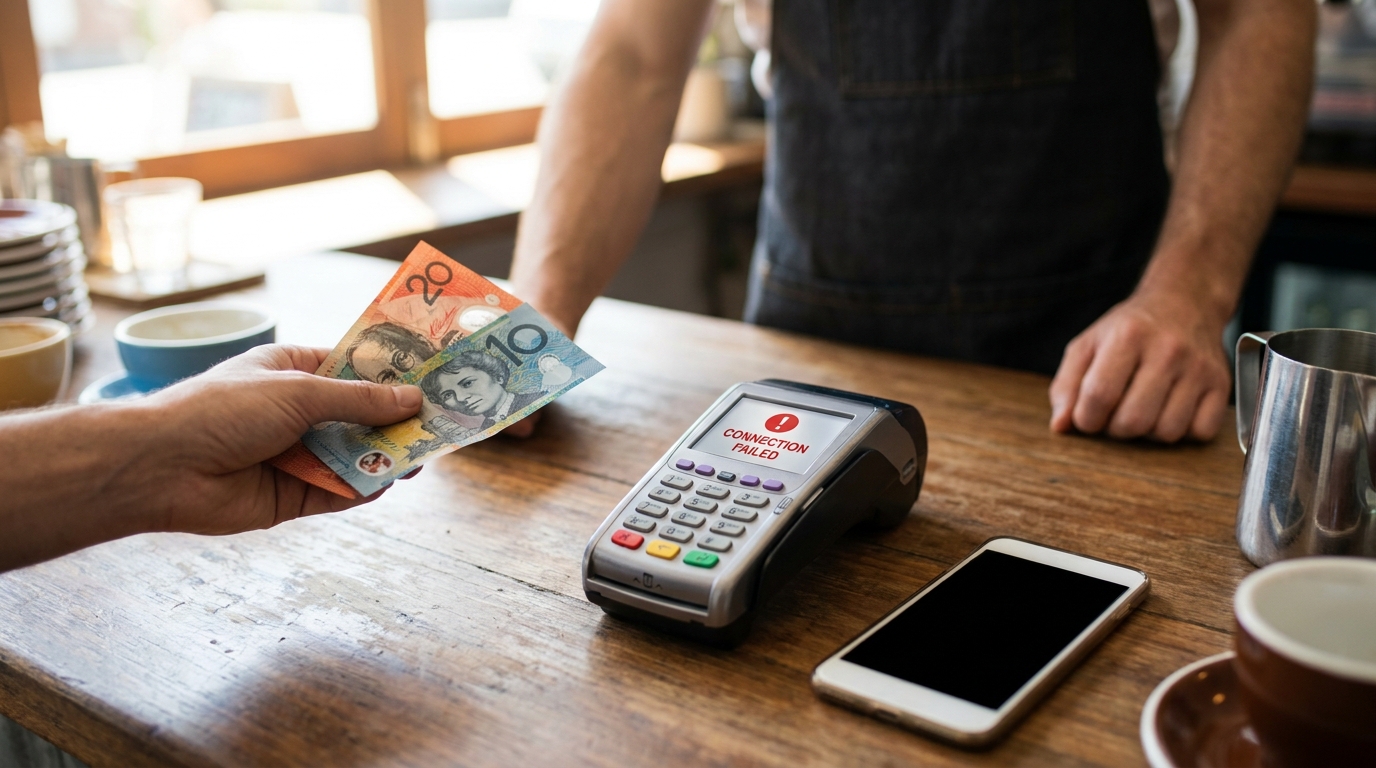
A chain of private systems
A tap takes a second. Behind it is a long chain: the telecommunications network, your eftpos provider, the payments switch, Visa or Mastercard themselves, and the bank that issued your customer’s card. Then all the way back again.
Every link is owned and run by a private company. Visa and Mastercard are listed companies. eftpos sits inside Australian Payments Plus, owned mostly by the big banks. They all charge for the trip, and any one of them can fail.
Cash is different. It’s public money, issued by the Reserve Bank and owned by all of us. Read more in The cash mandate: Australia backs cash.
It keeps happening
- 8 November 2023, Optus. The network was down for about 12 hours. More than 10 million people and 400,000 businesses were hit, and eftpos machines stopped working. The Senate inquiry laid out the damage.
- 19 July 2024, CrowdStrike. One faulty security update crashed about 8.5 million Windows computers. In Australia, self-checkouts and eftpos terminals went blank.
- 18 November 2025, Cloudflare. A fault inside a company most people have never heard of took major websites and apps offline around the world. Cloudflare says it wasn’t an attack.
- 27 January 2026, the Reserve Bank. A technology outage stopped some payments from processing for most of the day. Around 500 property settlements missed the deadline.
- 15 August 2026, Mastercard. A scheduled system update caused card payments to be declined across Australia from about 2:25pm to 4pm, including Apple Pay, the ABC reported. Some shoppers paid cash instead.
Most of these weren’t attacks. They were ordinary updates and changes that went wrong. That’s the point: it doesn’t take a crisis to stop digital payments. A bad Tuesday will do.
What happens at your counter
When the terminal goes down, a card-only business has nothing to sell with. Customers walk out. Some don’t come back.
A business that takes cash keeps trading. During the Optus outage, the businesses that could take cash kept serving. Those that couldn’t turned customers away.
Friday and Saturday only come 52 times a year
Australian households spend about $82 billion a month, according to the ABS. That’s around $2.7 billion every day.
It isn’t spread evenly. For most venues, Friday and Saturday are the big days: knock-off drinks, dinner out, the weekend shop, the footy. There are only 52 of each in a year.
Our own network shows it. On the ATMs Dash manages, Fridays and Saturdays account for 34% of all the cash withdrawn, from just two days of seven. Friday is the busiest day of the week, with 62% more cash going out than on a Monday.
of the cash withdrawn from Dash-managed ATMs comes out on Fridays and Saturdays
more cash withdrawn on a Friday than on a Monday
Lose one to an outage and you don’t get it back. Nobody comes back on Tuesday to buy the round they couldn’t pay for on Saturday night. That’s why payments outages cost businesses so dearly.
Cash is always on
Yes, an ATM can have downtime too. But it’s nowhere near as severe when you’ve already got cash in your pocket, or you can borrow some from someone who has.
Cash doesn’t need a signal, a server or a software update. It works person to person, every time.
Two days, one hour’s warning
Imagine the payments world was going to stop for two days, and you found out an hour before. What would you do?
We’d find an ATM.
So would your customers. Having an ATM in your business, and making it a critical part of how you operate, is more than insurance. It’s how your business keeps functioning when fragile payment systems fail.
The reality of digital payments is that you won’t know when they’ll go down next. It’s all too interconnected: the payments switch, the telecommunications network, your eftpos provider, the card issuer, Visa or Mastercard themselves. Any one of them can stop your counter.
Cash is the backup the system relies on
The Reserve Bank calls cash a valuable back-up to electronic payments, particularly during periods of disruption.
That backup only works if cash keeps moving every day: through ATMs, tills and cash-in-transit trucks. It’s one reason the Government now requires supermarkets and servos to accept cash. See The cash mandate: Australia backs cash, and why cash use is rising again.
Be ready before it happens
- Keep a cash float and enough change to trade for a day without cards.
- Make sure your staff know the drill: take cash, tell customers early, and keep a written record of sales.
- Never write down card numbers to process later.
- Have a second way to connect. A terminal on a different network can keep you going when one network fails.
- Put an ATM on site. It keeps cash in your customers’ pockets and your till every day, so when the network drops, there’s cash in the room.
What an ATM on site gives you
- Cash in your customers’ hands, inside your venue, every day.
- Fewer card fees, because more of your sales are paid in cash.
- Your own cash supply: load it with your takings, or bank them on site with a deposit-taking ATM and same-day settlement.*
- Managed for you: installation, cash logistics, fault alerts, reconciliation and national field service, all visible in the Dash web portal.
*Conditions apply. Deposit ATM subject to approval.
See the options to buy an ATM, or the deposit ATM for high-cash venues.
FAQ
What should I do if eftpos goes down?
Take cash, tell customers early, and keep a written record of sales. Keep a cash float so you can give change. Never write down card numbers to process later.
Does an ATM still work during an outage?
Sometimes. An ATM also needs a network to approve withdrawals, so a big outage can affect it too. The real backup is the cash already in your customers’ pockets and your till, and an ATM on site keeps that topped up every day.
Who owns Australia’s payment networks?
Visa and Mastercard are listed companies. eftpos is part of Australian Payments Plus, owned mostly by the big banks. Cash is issued by the Reserve Bank and owned by everyone.
Is cash going away?
No. Cash made up about 15% of payments in 2025, up from 13% in 2022, and supermarkets and servos must now accept it by law.
Dash ATM has built and managed ATM networks across Australia since 2012, led by founder Paul Wrigley, in the ATM industry since 2002. Let’s keep supporting cash.
Sources: Senate: The Optus network outage · Microsoft: the CrowdStrike outage · Forbes Australia: CrowdStrike outage · Cloudflare: 18 November 2025 outage · RBA: Statement on technology outage · ABC: Mastercard outage · ABS: Monthly Household Spending Indicator, July 2026 · RBA: Payments System Board Annual Report 2026 · Dash ATM network data, October 2025 to March 2026 · ACCC: AP+ merger determination · RBA Bulletin, April 2026: Cash Use in Australia